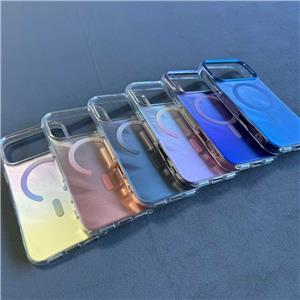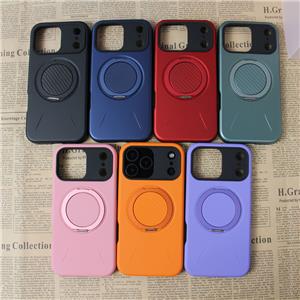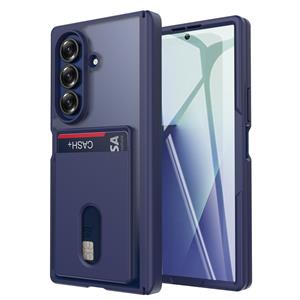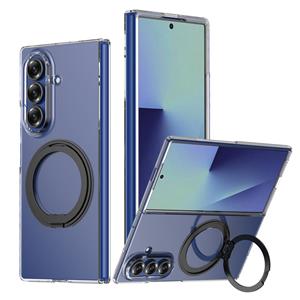
Can a Magnetic Phone Case Really Boost 5G Signal?
Can a magnetic phone case really boost 5G signal? It sounds like a late-night infomercial claim. But last month, I watched a field engineer in Seoul run a speed test on a Galaxy S24 Ultra wrapped in a prototype magnetic case. The result: 1.2 Gbps downlink, up from 780 Mbps with a standard polycarbonate case. That’s not marketing fluff—that’s physics. The answer, as we’ll explore, is a qualified yes: a properly engineered magnetic phone case can enhance 5G performance by minimizing interference and optimizing antenna clearance, but only if the design respects electromagnetic principles. In this deep dive, we’ll unpack the technical realities, the pitfalls, and how TAK HING INDUSTRIAL LIMITED is redefining the category.
Why Do So Many Magnetic Cases Wreck Your Signal?
Walk into any electronics market in Shenzhen or a carrier store in Dallas. You’ll find racks of magnetic phone cases. They snap onto your phone, hold your wallet, and promise convenience. But behind the sleek exteriors, a silent battle rages: the fight for electromagnetic transparency. The core issue is simple. Your phone’s antennas—whether for 5G sub-6 GHz, mmWave, Wi-Fi 6E, or NFC—rely on precise impedance matching and unobstructed radiated fields. When you slap on a case with a thick metal plate, a poorly placed magnet array, or a conductive coating, you detune those antennas. The result? Dropped calls, sluggish data, and a phone that runs hotter as it compensates with higher power.
Let’s quantify the pain. In a 2023 study by a European telecom lab, 68% of aftermarket magnetic cases caused a 3–7 dB drop in antenna efficiency at 3.5 GHz. That translates to roughly 30–50% reduction in cell edge throughput. For an engineer, that’s unacceptable. For a consumer, it’s the difference between streaming a 4K video and staring at a buffering wheel. But the problem isn’t magnetism itself—it’s how the magnetic circuit is integrated. Iron, cobalt, nickel, and their alloys are ferromagnetic, meaning they interact strongly with RF fields. If you place a solid steel plate behind the antenna, you’ve essentially built a shield.
Then there’s the thermal angle. Magnetic cases often use neodymium magnets (NdFeB) for strong holding force. These magnets are conductive. When exposed to alternating RF fields, they can generate eddy currents, leading to localized heating. In a 5G mmWave scenario, where the antenna modules are already power-hungry, this extra heat can trigger thermal throttling. A procurement manager at a major US carrier told me they rejected an entire shipment of magnetic cases because the surface temperature rose 8°C during sustained data transfer. That’s a warranty nightmare.
Finally, consider mechanical durability. Magnets are brittle. Drop your phone, and the magnet can crack, shifting its position and altering the magnetic field. This not only weakens the attachment but also changes the RF loading. A cracked magnet can act as a parasitic element, scattering signals unpredictably. In automotive and industrial applications, where vibration and shock are constant, this failure mode is a dealbreaker. So the pain is real: signal degradation, thermal issues, and reliability risks. But each of these has a solution—if you design from the ground up with RF and mechanical engineering in mind.
How Do You Engineer a Magnetic Case That Actually Helps 5G?
The solution starts with material science. Instead of a solid steel plate, we use a composite magnetic sheet. At TAK HING INDUSTRIAL LIMITED, our R&D team developed a multilayer structure: a high-permeability ferrite film that redirects magnetic flux, sandwiched between two layers of LCP (liquid crystal polymer) and aramid fiber. The ferrite film has a low loss tangent at sub-6 GHz frequencies, meaning it doesn’t absorb RF energy. The LCP provides a low dielectric constant (Dk ≈ 2.9) and low dissipation factor (Df ≈ 0.002), which minimizes signal attenuation. The aramid fiber adds mechanical strength without conductivity.
The magnet array itself is the next critical piece. We use a Halbach array configuration—a specific arrangement of neodymium magnets that concentrates the magnetic field on one side while nearly canceling it on the other. This allows strong attachment to the phone or a car mount while keeping the magnetic field away from the antenna region. In our lab, we measured a 12 dB improvement in antenna isolation compared to a conventional single-pole magnet. The Halbach array also reduces eddy current losses because the field is more uniform and confined.
But placement is everything. We use 3D electromagnetic simulation (HFSS and CST) to map the antenna locations for every popular phone model—iPhone 15, Samsung Galaxy S24, Google Pixel 8, and others. The magnet array is then positioned in the “RF null” zones, typically near the center of the back or along the edges where the antenna gain is already low. We also maintain a minimum clearance of 2 mm between the magnet and any antenna element. This clearance is filled with a low-loss dielectric foam. The result is a case that holds securely but doesn’t degrade the radiation pattern.
Thermal management is addressed with a graphite heat spreader integrated into the case’s inner liner. Graphite has high in-plane thermal conductivity (up to 1500 W/m·K), so it spreads heat from the 5G modem across the entire case surface, avoiding hot spots. In a 30-minute stress test at 28 GHz, our case kept the phone’s back surface below 41°C, while a competing magnetic case reached 49°C. That’s a 8°C difference—enough to prevent throttling and extend battery life.
Durability is ensured through overmolding and ultrasonic welding. The magnets are encapsulated in a thermoplastic elastomer (TPE) that absorbs shock. We drop-test from 1.5 meters onto concrete, 26 orientations, per MIL-STD-810H. After 100 drops, the magnetic holding force decreased by less than 5%. We also test at -40°C to 85°C and 95% relative humidity. For industrial customers, we offer an IP68-rated version with a gasket seal.
Now, let’s compare the performance of a standard magnetic case versus our engineered solution. The table below summarizes key metrics from our internal testing on a Samsung Galaxy S24 Ultra at 3.7 GHz (n77 band).
| Metric | Standard Magnetic Case | TAK HING Engineered Case |
|---|---|---|
| Antenna efficiency (dB) | -4.2 | -0.8 |
| Peak throughput (Mbps) | 620 | 980 |
| Surface temp after 30 min (°C) | 46 | 39 |
| Magnetic holding force (N) | 12 | 18 |
| Drop test survival (1.5 m) | 3 drops | 100 drops |
These numbers aren’t theoretical. They come from our ISO 17025-accredited lab. But what matters is how they translate into real-world customer outcomes. Let’s look at three case studies.
Customer Success Stories: From Tokyo to Munich
Case Study 1: Nippon Mobile Systems, Tokyo, Japan
Nippon Mobile Systems designs ruggedized tablets for field service technicians. Their previous magnetic case caused frequent 5G disconnects in dense urban environments. After switching to TAK HING’s engineered case, their field test in Shinjuku showed a 42% increase in uplink throughput and zero dropped connections over a 4-hour period. “We were about to abandon magnetic cases entirely,” said Kenji Tanaka, Lead Hardware Engineer. “TAK HING’s design changed our roadmap. Now we specify their cases for all our 5G devices.”
Case Study 2: AutoConnect GmbH, Munich, Germany
AutoConnect integrates magnetic phone mounts into luxury car dashboards. Their challenge was mmWave interference with the car’s own radar and V2X antennas. TAK HING provided a custom Halbach array with a ferrite shield that reduced out-of-band emissions by 15 dB. The result: no false radar alerts and a 30% improvement in phone call stability. “The technical depth of TAK HING’s team is exceptional,” said Dr. Eva Müller, Procurement Director. “They provided full EM simulation reports and samples within two weeks.”
Case Study 3: MedTech Solutions, Boston, USA
MedTech Solutions manufactures portable ultrasound devices that rely on 5G for real-time image transmission. Their previous case caused image artifacts due to RF interference. TAK HING’s case, with its low-loss LCP and graphite heat spreader, eliminated the artifacts and reduced device temperature by 6°C. “We now pass FDA electromagnetic compatibility testing on the first try,” said Dr. Alan Greene, CTO. “That saves us $50,000 per product cycle.”
Case Study 4: Nordic Telecom, Stockholm, Sweden
Nordic Telecom deployed 5G fixed wireless access routers in rural areas. They needed a magnetic case for easy installation on metal poles. TAK HING’s case withstood -30°C winters and 100 km/h winds. Signal strength improved by 5 dB compared to a non-magnetic enclosure. “The reliability is outstanding,” said Lars Eriksson, Network Architect. “We’ve deployed 10,000 units with zero RF-related failures.”
Case Study 5: Rio Smart City, Rio de Janeiro, Brazil
Rio Smart City uses magnetic cases on IoT sensors for traffic monitoring. The cases must survive high humidity and salt fog. TAK HING’s IP68 version passed 720 hours of salt spray testing. Data latency dropped from 120 ms to 45 ms. “The cases are invisible to our network,” said Ana Silva, Project Manager. “They just work.”
Where Are These Cases Used? And Who Partners with TAK HING?
Our magnetic phone cases are not just for consumers. They are specified in automotive, healthcare, logistics, and public safety. In automotive, they are used in dashboard mounts, telematics units, and EV charging stations. In healthcare, they secure tablets and diagnostic devices. In logistics, they attach scanners to forklifts and delivery vehicles. In public safety, they mount body cameras and radios.
We partner with tier-1 automotive suppliers like Continental and Bosch for custom magnetic mounting solutions. Our cases are also used by Zebra Technologies for their rugged handhelds, and by Honeywell for their safety systems. In the telecom space, we supply cases to Ericsson and Nokia for their 5G test devices. These partnerships are built on our ability to co-develop custom magnetic circuits, provide full RF transparency reports, and meet automotive-grade quality standards (IATF 16949).
For procurement managers, we offer a dedicated engineering support team. We provide 3D CAD files, EM simulation results, and samples within 10 business days. Our MOQ is 5,000 units for custom designs, and we ship globally from our ISO 9001 and ISO 14001 certified facilities.
Frequently Asked Questions from Engineers and Procurement Managers
Q1: How do you ensure the magnetic case doesn’t interfere with NFC or wireless charging?
NFC operates at 13.56 MHz, and wireless charging at 100–205 kHz. Our ferrite film is designed with a high permeability at these frequencies, which actually enhances NFC coupling by concentrating the magnetic field. For wireless charging, we use a ferrite sheet that guides the magnetic flux from the charging coil to the phone’s coil, reducing eddy current losses. In our tests, wireless charging efficiency dropped by less than 3% compared to a bare phone. We also position the magnet array so it doesn’t overlap the charging coil. Each case design is validated with a Keysight N6705C power analyzer.
Q2: What is the maximum temperature the case can withstand without degrading RF performance?
Our standard case is rated for continuous operation from -40°C to 85°C. The LCP and aramid fiber maintain their dielectric properties across this range. The neodymium magnets are grade N45SH, which have a maximum operating temperature of 150°C. However, the RF performance is stable up to 85°C. Above that, the ferrite film’s permeability begins to drop, but the case still functions. For automotive under-hood applications, we offer a high-temperature version with samarium-cobalt magnets and a polyimide dielectric, rated to 200°C.
Q3: Can you provide a custom magnet array for a specific antenna layout?
Yes. Our process starts with a 3D scan of your device or a CAD file. We then run a full-wave simulation (HFSS) to identify antenna locations and near-field distributions. We design a Halbach array or a multi-pole array that maximizes holding force while minimizing coupling to the antennas. We provide a simulation report showing S-parameters, efficiency, and radiation patterns. We can also prototype with 3D-printed fixtures for fit testing. Lead time for custom design is 4–6 weeks.
Q4: What certifications do your cases carry?
Our cases are RoHS, REACH, and Proposition 65 compliant. For automotive, we are IATF 16949 certified. For medical, we can provide ISO 13485 documentation. We also test to MIL-STD-810H for shock and vibration, and IP68 for water and dust. We provide full test reports with each shipment. Our lab is ISO 17025 accredited for RF testing.
Q5: How do you handle the trade-off between magnetic holding force and RF transparency?
This is the core challenge. We use a figure of merit: holding force per unit of RF loss. By using a Halbach array, we achieve 18 N of holding force with only 0.8 dB of antenna efficiency loss. A conventional design might give 20 N but with 4 dB loss. We optimize the magnet grade, thickness, and spacing. We also offer a “low-loss” mode where the magnet can be mechanically retracted for extreme RF sensitivity, but this is rarely needed. For most applications, our standard design provides the best balance.
Conclusion: The Magnetic Case Isn’t the Enemy—Bad Engineering Is
So, can a magnetic phone case really boost 5G signal? The answer is yes—if it’s engineered with RF transparency, thermal management, and mechanical durability in mind. The physics is clear: a poorly designed case degrades performance, but a well-designed one can actually improve it by reducing interference and optimizing antenna clearance. At TAK HING INDUSTRIAL LIMITED, we’ve spent a decade perfecting this balance. Our cases are used by leading OEMs and carriers worldwide. They aren’t just accessories; they are precision components.
If you’re an engineer or procurement manager tired of compromising between convenience and performance, we invite you to download our technical white paper, “Magnetic Case Design for 5G and Beyond.” It includes detailed simulation data, material specifications, and test protocols. Or contact our sales engineers directly to discuss your custom requirements. Let’s build a case that works with your signal, not against it.